Frequently Asked Questions
Can these AI computers be mounted vertically on standard mobile carts?
Yes. Both the Ai2 and Ai3 include a unique, flexible mounting plate that supports horizontal or vertical orientations. They are fully compatible with heavy-duty medical carts, articulation arms, and clinical wall mounts.
Do these systems require connection to the cloud to perform AI inference?
No. Cybernet Medical AI computers are built specifically for edge computing. By processing algorithms locally on internal NVIDIA® hardware, you eliminate data latency, save network bandwidth, and ensure total data privacy without relying on a constant internet connection.
Are the enclosures built to handle harsh clinical disinfectants?
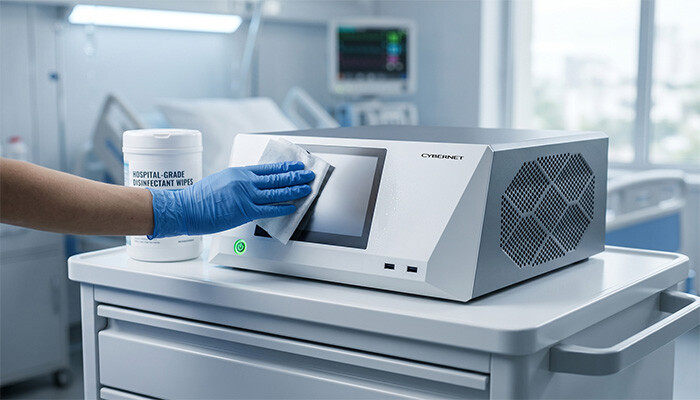
Yes. The front panels and exterior chassis materials are ruggedized to withstand routine chemical wipe-downs with hospital-grade sanitizers, making them fully compliant with standard ICU and operating room infection control protocols.
Does Cybernet assist with custom OS imaging and software deployment?
Absolutely. As a direct OEM, we can pre-configure your units with custom Windows 11, Windows IoT, or Linux builds. We can also preload proprietary software images, SDKs, or frame grabber drivers at our facility, ensuring units arrive fully plug-and-play.
What kind of power supplies do these high-GPU units utilize?
To satisfy the power draws of high-tier NVIDIA RTX GPUs, these platforms feature built-in, highly efficient medical-grade internal power supplies (ranging up to 1000W based on the model and GPU configuration). These power supplies carry full medical certifications to manage leakage currents and guarantee stable voltage regulation under intensive compute tasks.
What is the typical deployment lifespan for these machines?
Cybernet uses an embedded hardware roadmap for our medical products. We guarantee component availability and configuration consistency for up to five years from launch, protecting your IT deployments from the rapid component turnover typical of the consumer PC lifecycle.
What makes a computer a "Medical AI Computer" versus a standard medical PC?
A medical AI computer is specifically designed with discrete hardware acceleration—such as NVIDIA® RTX™ Tensor Core GPUs—and advanced multi-core processors to run complex artificial intelligence, deep learning, and computer vision algorithms locally at the edge. While standard medical PCs are built for charting, EMR access, and running basic clinical software, AI computers possess the heavy-duty compute power and thermal engineering required to process massive imaging and mathematical datasets with near-zero latency.
Why is edge AI processing preferred over cloud-based AI in a hospital setting?
Edge processing runs AI algorithms locally on the hardware right at the patient's bedside or inside the operating theater. This approach delivers three major advantages over cloud architecture:
- Zero Latency: Immediate data processing, which is critical for real-time surgical computer vision or high-acuity triage.
- Data Security & HIPAA Compliance: Patient data is processed locally and does not need to be transmitted across external internet networks, minimizing data intercept vulnerabilities.
- Network Redundancy: The AI tools continue to function perfectly even if the hospital's external internet connection drops.
What does IEC 60601-1 certification mean for AI computers in patient care areas?
IEC 60601-1 is a strict global safety and performance standard required for medical electrical equipment in direct proximity to patients. For an AI computer, this certification guarantees advanced electrical isolation (ensuring near-zero electrical leakage currents) and full electromagnetic compatibility (IEC 60601-1-2). This prevents the computer's heavy-duty internal power supplies and graphics cards from causing electrical safety risks or emitting radio frequencies that could interfere with sensitive ventilators, anesthesia machines, or patient telemetry monitors.
How do medical AI computers assist clinical staff at the point of care?
Medical AI computers act as an automated, highly advanced second set of eyes for healthcare providers. Common use cases include:
- Real-Time Diagnostic Spectrometry: Running deep learning algorithms to detect micro-anomalies in tissue or fluid scans instantly.
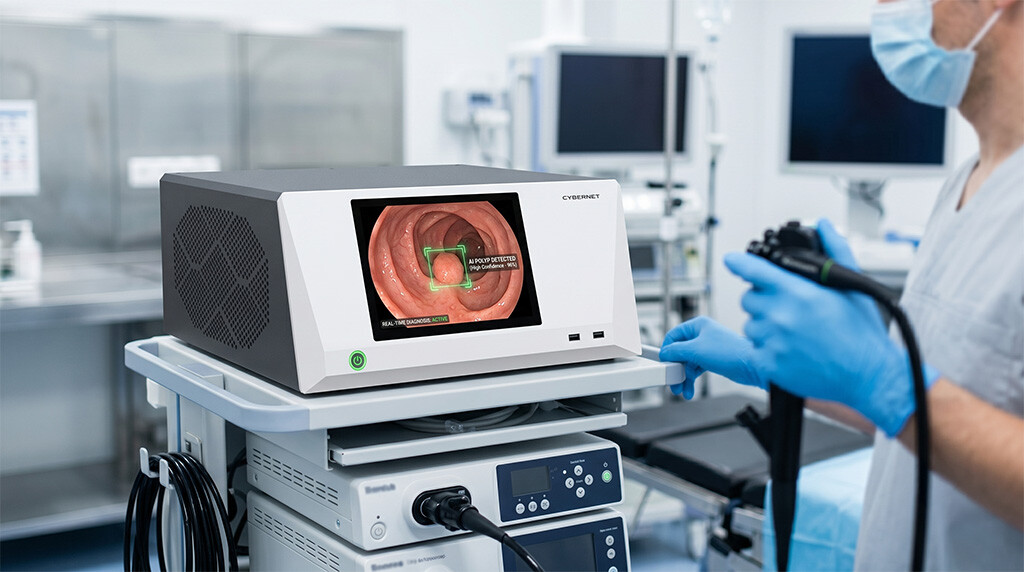
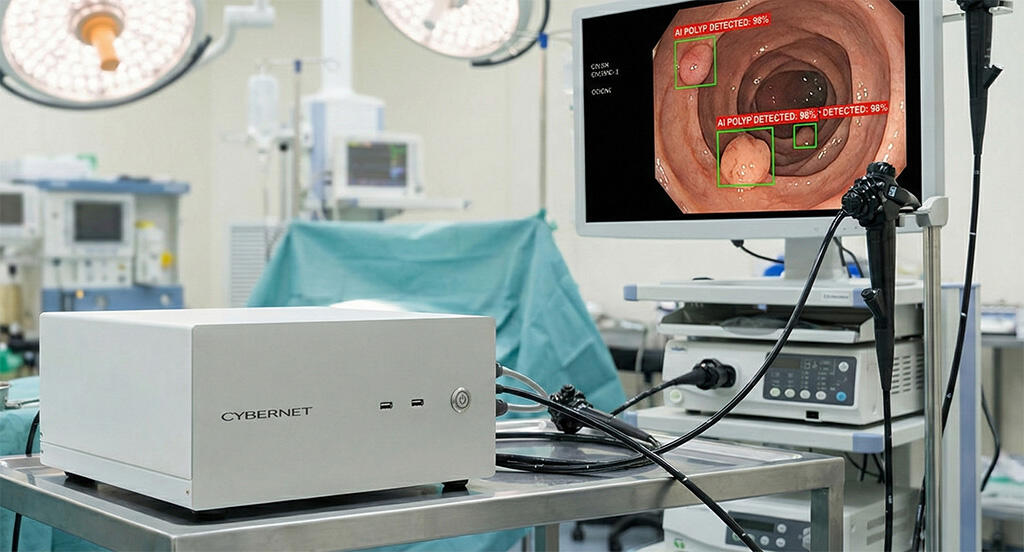
- Surgical Machine Vision: Overlaying digital anatomical guidance maps over live 4K endoscopic camera feeds during active procedures
- Predictive Patient Triage: Processing real-time vital sign data streams at the bedside to alert nursing staff of early signs of patient deterioration or sepsis hours before standard symptoms appear.
Can these systems handle multi-stream 4K video feeds for surgical applications?
Yes. Our high-tier medical AI computers can be configured with specialized onboard capture cards (supporting 12G-SDI and HDMI 2.0 architectures) capable of ingesting uncompressed 4K video at 60 frames per second. Backed by extensive system memory and high-bandwidth PCIe pathways, these machines can capture, display, and run parallel AI algorithmic models across multiple surgical video feeds simultaneously.
How do these computers withstand hospital infection control protocols?
The outer enclosures and front touch panels of our medical computers are constructed from rugged, non-porous, medical-grade materials. They feature water-resistant sealed chasses (up to IP65 ratings) intentionally engineered to withstand routine, aggressive sanitization with harsh clinical chemical disinfectants—such as isopropyl alcohol, chlorine-based wipes, and bleach—without structural deterioration or liquid ingress.
What operating systems and developer frameworks are supported?
To accommodate a wide array of proprietary clinical software, our AI hardware platforms are fully validated across Windows 11, Windows 10, Windows IoT Enterprise, and Ubuntu Linux distributions. They support standard AI/ML frameworks, software development kits (SDKs), and frame grabber libraries, allowing healthcare developers and medical device manufacturers to easily port their pre-trained machine learning models directly onto the hardware.
How do medical AI computers integrate with legacy hospital hardware?
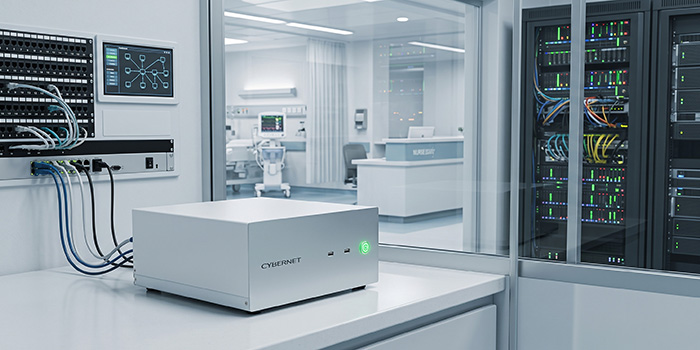
We design our computers with a rich array of modern and legacy inputs/outputs (I/O). Alongside high-speed USB-C, WiFi 7, and multi-gigabit LAN networks, our systems retain legacy physical interfaces like programmable COM serial ports (RS232/422/485). This allows hospitals to instantly modernize their facilities by plugging existing capital equipment—like older diagnostic spectrometry units or patient monitors—directly into a high-performance edge AI platform.
Does Cybernet provide custom branding or hardware tailoring for medical device vendors?
Yes. Through our comprehensive healthcare OEM/ODM services, Cybernet works closely with medical device manufacturers and software vendors who want to utilize our medically certified computers as the secure foundation for their own proprietary hardware suites. We offer hardware customization, specialized PCIe component mapping, custom BIOS configurations, unique corporate branding, and enterprise drive imaging to match your exact product specifications.