Electric vehicles (EVs) have gone from curiosities and trade show concepts to a common sight around the world, with over 20 million models sold in 2025 alone. With more EVs on the road than ever comes the need for more EV charging stations than ever as well.
However, EV charging stations are complicated devices in their own right and require reliable industrial computers to manage their functions and recharge vehicles safely and efficiently. Without rugged computer support, charging station operators can face equipment breakdowns, over- or under-charged batteries, and mismanaged transactions.
Types of EV Charging Stations and Their Roles
When discussing EV charging stations, it’s important to note the three levels of chargers and their different use cases.
- Level One: These chargers plug directly into a 120-volt household outlet and are often provided directly by EV manufacturers for consumers. Essentially, they allow you to recharge your EV the same way you would plug in a household appliance. Level 1 chargers are inexpensive but slow, recovering only 3 to 5 miles of range per hour of charging.
- Level Two: These devices are a step up from Level One chargers; they run at 240 volts (requiring an upgraded power supply) and must be physically installed in a household, similar to washing machines and electric ovens. In exchange, they are much faster, restoring roughly 20 to 40 miles of range per hour of charging.
- Level Three: Also called DC fast chargers, these are the most powerful chargers of all and serve roughly the same role as commercial gas stations. Owned and operated by businesses rather than at home, Level Three chargers use high-voltage direct current to charge EVs extremely quickly (reaching 80% battery charge in just 30 minutes).
Of these chargers, Level 3 devices are the most complex and the most in need of a truly rugged industrial computer to help manage their processes.
Vital Computing Tasks in Level 3 Fast Chargers
EVs use digital technology to manage most of their functions, and their charging stations are no different. A Level 3 charger relies on its built-in computer to perform numerous vital tasks, such as:
Communicate with the Vehicle’s Computer
When you plug the station’s charging cable into your EV, the station and vehicle share vital information via CAN bus and ISO 15118 protocols. This allows the station to verify charger compatibility, the initial state of charge (SoC), and ensure safety parameters are met before releasing any power.
Real-Time Charge Control & Safety
Once communications are established and safety protocols are satisfied, the charging process can begin. As electricity flows from the station to the EV, both machines monitor parameters like temperature, voltage levels, and battery response to ensure that no issues arise. If the station’s computer detects anomalous activity like fluctuating voltage or a temperature spike, it can automatically shut down the charging process before an accident occurs.
Computers also manage the charging curve, such as rapidly charging to 80%, then tapering off to prevent overcharging and protect battery health.
Complete Transactions
Once the charging process is complete, all that remains is the payment. Some charging stations use credit card readers the same way gas stations do, while others rely on phone-based apps, scannable QR codes, or Plug & Charge payment protocols to complete transactions. Computer systems handle connectivity via Open Charge Point Protocol, enabling network communications for dynamic pricing and grid management.
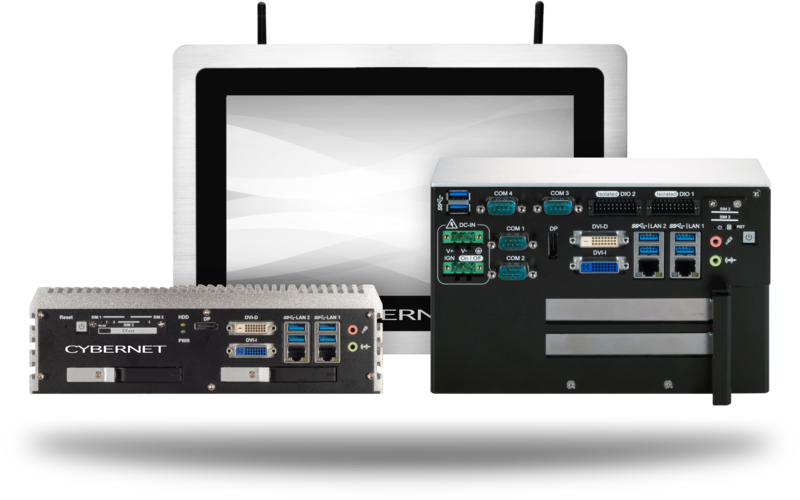
Hardware Architecture: All-in-One Panel PC vs. Embedded Box PC
EV charging station original equipment manufacturers (OEMs) typically choose between two architectural designs for their control hardware:
|
Feature / Criteria |
Integrated Industrial Panel PC |
Embedded Box PC + Separate Monitor |
|
Space & Cabling |
Integrated display and computer; reduces internal cabling |
Requires internal mounting space and display cabling |
|
Maintenance & Serviceability |
Streamlined installation, but screen damage requires full unit replacement |
Swap display or box PC independently if vandalized or damaged |
|
I/O & Expandability |
Standard I/O ports for typical touch interface needs |
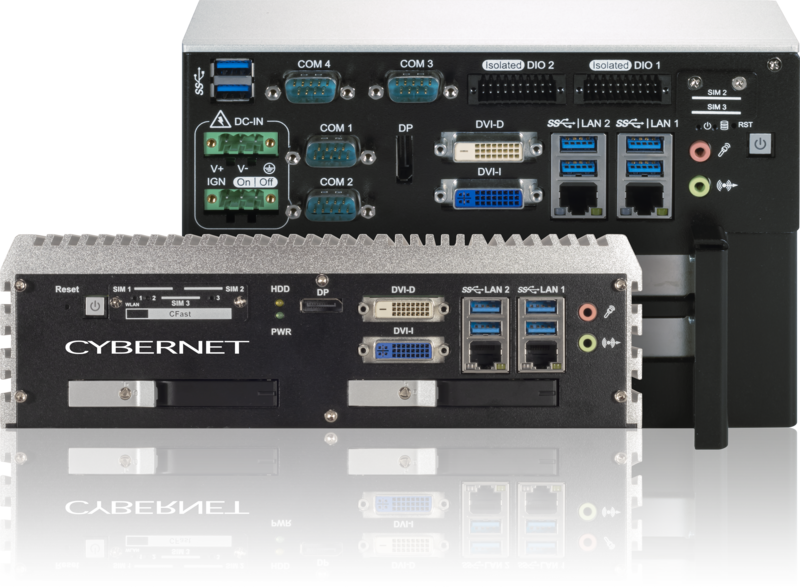
High I/O density (COM, CAN bus, dual LAN) for complex sensor arrays |
|
Ideal Application |
Sleek commercial kiosks and space-constrained Level 2/3 chargers |
Heavy-duty, modular Level 3 DC Fast Chargers |
Key Challenges for Charging Station PCs
As pieces of industrial equipment that operate outdoors, EV charging stations and their various components face a wide range of environmental challenges and design considerations. When selecting a computer to serve in a charging station, make sure it is prepared for issues like:
Weather and Dustproofing
Level 3 charging stations located outdoors are completely exposed to the elements and will face the full brunt of local weather. Rain, snow, dust, and other environmental factors will inevitably try to enter the station’s casing and affect the electronic components within.
To protect against this, the charging station’s casing and any customer-facing screens should have high ingress protection ratings. A display with an IP65-rated front bezel, for example, will lock out dust and water from getting in and damaging its circuitry, preventing an expensive breakdown.
Fanless Cooling Solutions
Traditional consumer-grade computers rely on cooling fans that draw in airborne contaminants and rely on moving parts vulnerable to mechanical failure. Fanless industrial computers use passive heatsink cooling, which eliminates ingress pathways and reduces the number of moving parts in the charger, improving overall system lifespan.
Wide Temperature Ranges
Depending on its location, an outdoor EV charging station can face temperatures far below freezing or well into triple digits on the Fahrenheit scale. Thus, any electronic component used at the station, including computers, needs a wide operating temperature range. -13°F (-25°C) to 158°F (70°C) is an ideal range, as it covers the typical range of temperatures an outdoor fixture will face and beyond.
Vibration and Bumps
Because they operate so close to running vehicles, EV charging stations and any computers inside them will inevitably face vibrations and the occasional bump. These vibrations can jostle disk platters, disconnect wiring, and even disrupt the connections of components on the computer’s motherboard.
To counter this, the station’s computer should use vibration-resistant components and design features, such as solid-state drives rather than hard-disk drives and soldering components directly onto the motherboard. These designs are tested to IEC 60068-2 shock and vibration standards to ensure they can withstand real-world operating conditions.
Voltage Input Protection
Grid fluctuations and power surges can easily ruin commercial-grade electronics and brick the entire charging station. Industrial mini PCs feature wide-range DC power input (9V - 36V) to protect against volatile power environments.
Low Maintenance Requirements
EV charging stations need to be operational 24/7 with minimal maintenance and support. Most charging stations don’t have any staff onsite at all, forcing customers to contact the owner via a phone call or in-app messaging for assistance.
Any computer used in a charging station, whether a panel PC or a box-and-monitor combination, needs to be proven to work in adverse conditions for extended periods. Our industrial computers, for example, have a failure rate below 0.5%, a testament to our design and engineering process.
Support Charging Stations with Cybernet Computers
As global EV adoption accelerates, station uptime directly dictates brand reputation and profitability. Charging station manufacturers need hardware built to survive years of continuous outdoor use.
At Cybernet Manufacturing, we design and manufacture custom industrial panel PCs and fanless mini PCs with a near-zero failure rate (<0.5%). As an OEM specialist, our engineering team works directly with EV infrastructure developers to customize I/O ports, screen brightness, mount designs, and legacy board integration.
Ready to build reliable charging stations? Contact Cybernet Manufacturing today to speak with an expert about custom computing solutions.