Hospitals are now digital workspaces, and the pharmacy is no different. Pharmaceutical computers are critical for managing the production of medication, tracking patient information, and more.
However, the unique working conditions of a pharmacy require specialized computers to serve healthcare providers and support their efforts. From the physical design to the software they use, pharmacy computers must be carefully considered before committing to a purchase.
What Pharmacy Computers Need To Be Cleanroom Ready
Given that the vast majority of important pharmaceutical work takes place within a cleanroom, any pharmacy computer must also be cleanroom-ready. The most critical of these requirements are:
Fanless Cooling
First and foremost, any computer used in a cleanroom, pharmaceutical or not, cannot rely on fans to deliver cooling. This is because fans, which blow hot air away from a PC’s components and cool air over them, also spread dust and microbes. In a carefully controlled environment like a pharmaceutical cleanroom, this is unacceptable, as it can disrupt and compromise any medication being prepared.
Therefore, pharmaceutical computers must rely on fanless cooling to prevent overheating. These designs, which implement radiative heatsinks and zero moving parts, don’t displace air to do their job, preventing the spread of dust or microbes. This also comes with the benefit of being more reliable than your typical computer reliant on fan-based cooling, as the lack of moving parts removes the chances of a mechanical breakdown.
These features are exactly why Cooper University Healthcare chose Cybernet’s medical panel PCs for their pharmacy clean rooms, providing the pharmacy team with a reliable, safe computer solution.
Easy Cleaning and Disinfection
Along with the need to disrupt the air as little as possible, every surface and object in a cleanroom needs to be cleaned and disinfected frequently to prevent contamination and the spread of disease. An all-in-one PC is ideal in this scenario, as the flat surface of its touchscreen panel is far easier to clean than, say, a keyboard with gaps between the keys where microbes can replicate and spread.
One critical concern, however, is preventing cleaning chemicals and disinfectants from seeping through cracks and gaps in the PC’s case. A proper medical panel PC will have an IP65-rated front bezel, meaning it is sealed tight against both dust and water, allowing it to be thoroughly cleaned without concern.
Electromagnetic Reliability
Like any other medical computer, computers used in a pharmaceutical cleanroom must meet basic standards for electromagnetic safety, as codified by IEC 60601-1. Adhering to IEC 60601-1 and 60601-1-2 helps ensure that a pharmaceutical computer won’t disrupt or be disrupted by other devices operating nearby. In turn, this helps ensure a safe and reliable workflow that delivers life-saving drugs to patients at the hospital.
Glove-Friendly Touchscreen Controls
While touchscreens are incredibly useful, they often have one significant disadvantage: they cannot detect inputs made while the user is wearing gloves. Obviously, this is a major issue in a medical or cleanroom setting, where gloves are required attire. Many consumer-grade panel PCs still suffer from this issue, making them unsuitable for pharmaceutical work.
A medical all-in-one PC, however, is designed with this issue in mind. Our medical panel computers come with capacitive touchscreens sensitive enough to detect input even when the user is wearing nitrile gloves, so you don’t have to compromise on safety and sanitation to keep using your computer-based tools.
EMR and Workflow Compatibility for Pharmaceutical Computers
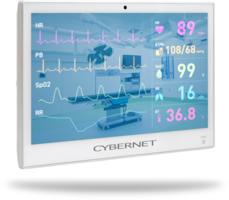
A key concern for any medical computer, whether used in the pharmacy or the operating room, is compatibility with your pre-existing workflows and tech-stack. This includes both hardware and software concerns.
Hardware
Pharmacies have numerous devices that can be connected to a pharmaceutical computer for easier management, such as refrigerators, capsule machines, ointment mills, compounding machines, and more. However, any pharmaceutical computer you plan to use needs to be able to connect to these devices in the first place.
This means that any pharmacy computer should have a wide range of both modern and legacy I/O ports, allowing for full connectivity with multiple devices. Including legacy ports, such as serial or VGA ports, also allows a hospital’s pharmacy to continue using older equipment rather than replacing it, resulting in significant budget savings. Before committing to a purchase, confirm with the computer’s manufacturer that it can physically interface with your equipment.
Software
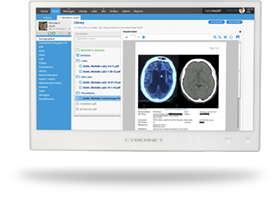
Pharmacists and other healthcare providers rely on electronic medical records (EMRs) to receive and update information about patients, including which medications they’re supposed to receive. Therefore, any computer selected for the pharmacy must be able to access and support modern EMR solutions, such as Epic and Oracle Health. This includes factors like enough processing power to support these programs, and even screen size to display all of the EMR’s information.
When shopping for a new pharmacy computer, make sure it supports your current EMR solution. Without this support, it’ll just be an expensive plastic brick sitting in your IT department.
Compact Designs
Most of the important work in a pharmacy takes place under the containment hood, a contained space used to mix and handle medications safely. The nature of this hood, along with the various other tools and supplies pharmacists require, means that there is often very little space for other devices, including computers.
The slim design of an all-in-one medical PC makes it much easier to fit under the containment hood, as it combines the monitor and computer into a single, relatively thin and flat device. Panel PCs are also compatible with common mounting solutions such as VESA, making it even easier to fit them under the hood.
Pharmacy-Ready Medical Computers from Cybernet Manufacturing
Embracing computer technology in the pharmacy offers greater accuracy and a smoother workflow, ensuring that patients receive the medication they need when they need it most. When it comes to pharmaceutical computers, however, a medical panel PC is clearly the best choice.
If you’d like to speak with an expert on medical and pharmaceutical computers, contact the experts at Cybernet Manufacturing. Our line of medical panel PCs is tested and proven ready for pharmacy and cleanroom roles, and is compatible with the full suite of medical software tools.