Every time patient information gets stuck in the wrong system, someone pays for it: the patient who waits longer for treatment, the provider who has to repeat their work, and the organization that absorbs the cost.
Clinical data fragmentation affects patients, providers, and the healthcare systems they move through, leading to delayed treatment, higher costs, and more misery. This guide breaks down each aspect of fragmentation, its solution, and how the right medical-grade hardware turns good intentions into workflows that actually stick.
What is Clinical Data Fragmentation?
Clinical data fragmentation happens when a patient's information is scattered across systems, servers, documents, and applications that don't talk to each other. Follow a single patient, and it can look like this:
- Health records that live in the EHR database.
- Imaging and diagnostics sitting in a separate imaging system.
- Prescriptions logged in a pharmacy database.
- Specialist visits that are recorded in yet another system.
No single provider sees the whole picture, or they end up with different conflicting versions of the same picture. Without a unifying system across these roles, fragmentation is inevitable.
The Consequences of Clinical Data Fragmentation
Both patients and providers suffer from fragmented data. Here's what it costs each side.
For patients:
- Repeated tests because results didn't transfer cleanly
- Repeated requests for records caused by EHR mismatches
- Higher out-of-pocket costs and premiums in private healthcare systems
- Lost trust, leading patients to drop treatment plans or switch providers
For providers:
- Burnout, with nearly 42% of physicians reporting at least one symptom
- Redundant work correcting records and scheduling duplicate tests
- Poorer clinical decisions when key information is missing
- Legal exposure to malpractice and medical injury claims
Fragmentation at a Glance
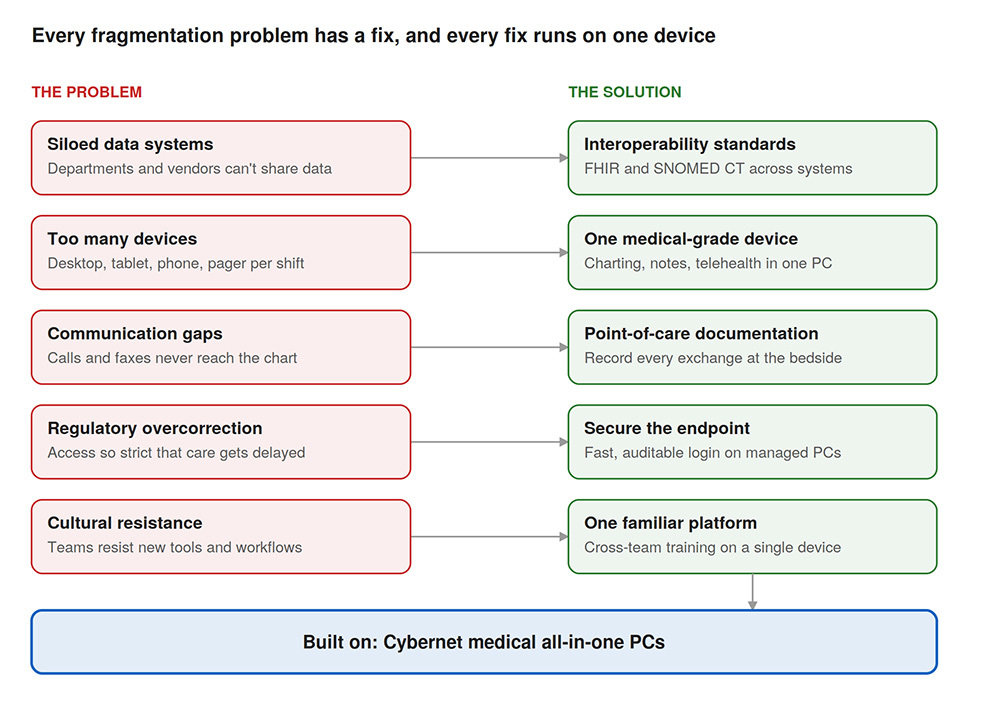
Each cause of fragmentation has a matching fix, and each fix depends on reliable point-of-care hardware. See how Cybernet’s all-in-one medical PCs and tablets fit into your workflows with a 30-day demo.
Problem 1: Siloed Data Systems
The problem: Data silos form when a single department controls a database that other teams can't easily reach. Silos often form for understandable reasons:
- Security concerns lead departments to lock data down.
- Different vendors for EHRs, imaging, and prescription management don't share formats.
- No common vocabulary means different systems use different terms for the same subject. One system records a patient’s heart rate as “Heart Rate,” another as “HR,” and another as “BPM,” for example.
The solution: Build on interoperability standards.
- Adopt FHIR (Fast Healthcare Interoperability Resources) so software shares data in a common digital format.
- Standardize clinical terms with SNOMED CT and LOINC so every system describes the same condition the same way.
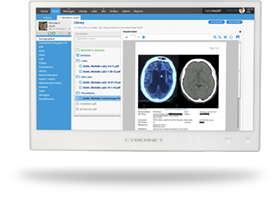
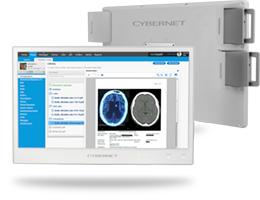
- Run that software on medical all-in-one PCs with the processing power and connectivity to access EHR, imaging, and pharmacy systems from one workstation, at the point of care.
Problem 2: Too Many Devices, Too Many Gaps
The problem: Most providers juggle a patchwork of hardware during a single shift:
- A desktop computer to access patient EHRs
- A tablet for rounds
- A phone to call other providers
- A pager for alerts
Every handoff between devices is a chance for critical information to go unrecorded. A note typed on a phone has to be retyped into the EHR later, if it gets there at all.
The solution: Consolidate onto one medical-grade platform.
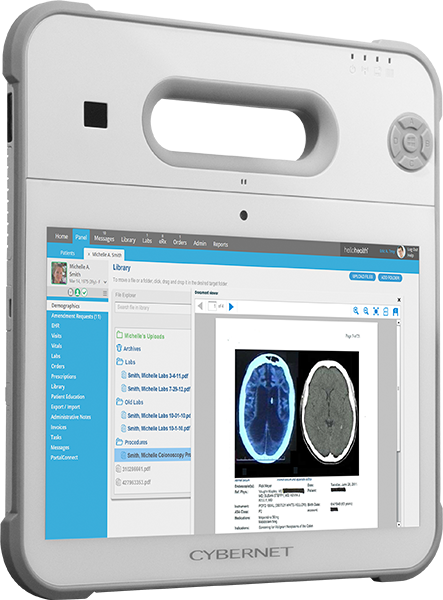
- Use a single medical computer or tablet that handles charting, note-taking, and telehealth communications.
- Cut transcription time so providers spend more of their shift treating patients.
- Choose hardware built for clinical environments, with IEC 60601-1 certification for safe use around patients and equipment.
This is where Cybernet medical all-in-one PCs fit: one certified device that replaces the patchwork, so information is captured once, in the right place.
Problem 3: Communication Gaps and Paper Trails
The problem: When records and updates travel through disconnected channels, details slip through:
- Paper records at another hospital mean calls, transfer requests, faxes, and printouts, while the patient waits.
- Phone calls, emails, faxes, and personal messaging apps carry updates that never make it into the chart.
- A prescription change agreed by phone may never be logged, leaving the bottle label and the EHR out of sync.
The solution: Make the EHR the place where communication happens, not an afterthought.
- Route consults and updates through EHR-integrated messaging and telehealth so every exchange is recorded.
- Put a medical all-in-one PC at the bedside or nurse station, so documenting a call takes seconds instead of a trip back to the office.
- Retire fax-and-print workflows in favor of digital record transfers built on shared standards.
Problem 4: Regulatory Overcorrection
The problem: Regulations like HIPAA protect private health information for good reason. But fear of a breach can push organizations to overcorrect:
- Access controls so strict that providers can't reach records they need to treat a patient.
- Multiple approval steps that delay care and add cost.
- Workarounds like personal phones and texts that create more risk, not less.
The solution: Secure the endpoint so data can move safely.
- Deploy hardware with built-in cybersecurity features, such as smart card and RFID readers for fast, auditable login.
- Give authorized users quick access at the point of care, so they don't need risky workarounds.
- Keep protected health information on managed, medical-grade devices instead of personal phones.
When the device itself is secure, organizations can expand access without increasing risk.
Problem 5: Cultural Resistance and Tool Fatigue
The problem: Technology alone can't fix fragmentation if people won't use it. Common barriers include:
- Competing priorities: the ED, oncology, and pharmacy each need different things from the data, and resist changes that seem to serve another team.
- "Us vs. them" thinking: adversarial relationships between departments, even in collaborative settings.
- Tool fatigue: new tools often feel like more work, and providers rarely get time to properly train with them.
The solution: Pair a collaborative mindset with tools people actually want to use.
- Run cross-departmental training so teams understand each other's challenges.
- Choose one familiar, consistent device across departments, so staff learn a single platform instead of four.
- Pick hardware that reduces clicks and transcription, so providers see the benefit on their first shift.
Close the Gaps with Cybernet Medical Computers
Preventing fragmentation takes all three pillars of healthcare technology working together: software, hardware, and the people who use both. Interoperable software and a collaborative culture only pay off when providers have a reliable device to run them on.
Cybernet medical all-in-one PCs give your teams that foundation:
- One device for every workflow: charting, notes, imaging review, and telehealth
- Medical-grade design: IEC/UL 60601-1 certified and IP65 tested for clinical environments
- Built-in security: protects private health information at the point of care with TPM-based encryption and Imprivata SSO
- Proven expertise: decades of designing, manufacturing, and deploying solutions in high-stakes medical environments, with a failure rate below 0.5% to prove it
Ready to stop data from falling through the cracks? Contact the experts at Cybernet Manufacturing to find the right medical computer for your facility.